My e-book on e-books

I just had to do this… I’ve just published my collected articles and blogposts on e-books and e-readers as an EPUB document. I used the platform pressbooks.com to create the book. It’s a very clever concept basing on WordPress. I could create for each article a chapter in WordPress and then integrate text and images. The blog posts from two different WordPress blogs I could export out of the original blogs and then directly import into pressbooks. Only the date published I had to add manually – and to put them all in the right order was manual work. In the web edition also the comments to the blog posts are still available.

As a result the e-book about e-books is now available as a web edition on mrudolfebooks.pressbooks.com and as an EPUB file that you can download from here. As I didn’t want to publish it in a commercial shop I just give access from here. But maybe I need to get an ISBN and then publish it officially on Amazon and iBookstore? What do you think. I’m looking forward to your comments!

By the way the articles are mostly written in German, but there are also some articles and blog posts in English. Hope that’s alright for you!

And by the way there is also a mobipocket version available, just in case you use a Kindle…

e-book Mobipocket (version 1.01)

E-Books als eigenständiges Medium

there is an english version of this post

In den vergangenen Wochen habe ich mich recht intensiv mit E-Books befasst. Ursprünglich haben mich E-Books als Medium interessiert, das auf E-Readern und Tablets gelesen werden kann – oder auch nicht. Mittlerweile steht das Medium selber im Fokus. E-Books haben meiner Ansicht nach ein grosses Potential, das heute bei weitem noch nicht ausgeschöpft wird. Ich habe im Beitrag über E-Books als Katalysator für Veränderungsprozesse in Bibliotheken einige Gedanken geäussert, welchen Einfluss E-Books auf Geschäftsprozesse und Aufgaben von Bibliotheken haben können.

Doch es geht noch weiter. Mehrere wichtige aktuelle Trends aus dem Hochschulumfeld finden sich im Thema E-Books wieder: die Selbstproduktion digitaler Lehrbücher, die Publikation unter Open Access, E-Books als multimediale und interaktive Medien im E-Learning, die Bereitstellung von Inhalten zur mobilen Nutzung und noch mehr…

Das neue Format EPUB 3 öffnet verschiedene Türen. Momentan haben wir es bei den E-Books noch weitgehend mit einer elektronischen Version des gedruckten Buches zu tun. Wie bei früheren Entwicklungsschüben bildet das neue Medium E-Book zunächst einmal das alte Medium gedrucktes Buch ab. Dafür ist das Format PDF (als PostScript-Datei) wunderbar geeignet, da es ja der Druckausgabe eines auf dem Computer generierten Dokuments entspricht. Layout, Schrift, Zeilen- und Seitenumbruch entsprechen vollkommen dem zum Printer geschickten Dokument. Das Format EPUB hat in seiner ursprünglichen Form schon einige Elemente aufgeweicht: so geht der ursprüngliche Zeilen- und Seitenumbruch verloren, das Layout passt sich dem darstellenden Gerät an – genauso wie Webseiten im Browser. Gegenüber dem gedruckten Buch verändern sich die Seitenzahlen, wodurch die wissenschaftliche Zitierung im herkömmlichen Stil erschwert wird. Und durch die Möglichkeit, auch Videos und Töne in ein Dokument zu integrieren, bewegte es sich schon etwas weiter vom gedruckten Pendant weg. Doch das war nur der Anfang.

Das Format EPUB 3 bildet nun die Ausgangslage für eine Emanzipation des E-Books vom gedruckten Buch. Technisch gesehen ähnelt ein E-Book im EPUB-Format einer Website. EPUB 3 besteht aus zusammengepackten Dateien im Format HTML5, aus Mediendateien wie Rastergrafiken (z.B. im Format JPEG), Video oder Ton. Vektorgrafiken im Format SVG können interaktive Elemente enthalten. Interaktion kann optional auch mit Javascript programmiert werden, was ebenfalls aktueller Webtechnologie entspricht. Diese Technologien können dazu eingesetzt werden, um E-Books im EPUB 3-Format mit interaktiven Elementen auszustatten, wie wir sie aus dem Web bereits kennen. Lehrbücher lassen sich mit Prüfungs- oder Kontrollfragen ergänzen. Lernkontrollen können also im E-Book direkt erfolgen. Man kann Grafiken so gestalten, dass sie beim Anklicken oder bei Berührung via Touchscreen verändert werden. Dreidimensionale Objekte können gedreht werden und vieles mehr. Multimedia-Inhalte wie Videos oder Sound lassen sich integrieren und abspielen. Dies alles sind reine Funktionen des Formats EPUB 3, die von geeigneten Programmen (sprich: Apps) auf PCs oder Tablets abgerufen werden können. Aktuell sind es noch nicht viele Geräte und Programme, doch dies wird sich bald ändern.

Technisch bieten sich somit zahlreiche Möglichkeiten. Nun stellt sich die Herausforderung, diese Funktionen sinnvoll in E-Books zu integrieren. Es ist genau die gleiche Fragestellung wie sie auch im Bereich E-Learning die letzten Jahre diskutiert wurde. Entsprechend sind die Lösungsansätze auch hier zu suchen. Technische Machbarkeit alleine genügt nicht. Es müssen didaktische und pädagogische Konzepte entwickelt werden, wie diese vielfältigen Funktionen sinnvoll in neue Medien integriert werden können. Aus dem E-Learning liegt hier ein reicher Erfahrungsschatz vor.

Doch überschneiden sich jetzt die Produktion von Lehrinhalten mit der Publikation von Forschungsergebnissen. Es drängt sich also eine Zusammenarbeit der E-Learning-Stellen mit den Hochschulbibliotheken auf. Letztere sind für die Publikation der an der Hochschule selbst produzierten E-Books unter Open Access verantwortlich. Als neue Aufgaben könnten die Beratung von Hochschulangehörigen beim Produzieren der E-Books sowie die Bereitstellung einer entsprechenden Publikationsplattform – etwa im Sinne eines erweiterten Dokumentenservers – zum Portfolio der Bibliothek hinzu kommen. Die Beschreibung der E-Books mit geeigneten Metadaten wäre eine Erweiterung des bisherigen Bibliotheksauftrags.

Wir befinden uns an einem spannenden Punkt, an dem wichtige Weichen für die Zukunft gestellt werden. Verlage, Buchhändler, Hochschulen und Bibliotheken müssen ihre Rollen neu definieren, wollen sie weiterhin eine Rolle im Bereich des elektronischen Publizierens spielen. Wer sich nicht bewegt, hat in diesem Spiel schlechte Karten. Und ich sehe eine zunehmende Bedeutung der Kooperation innerhalb der Hochschulen, um unterschiedliches Know-how gemeinsam zur Produktion und Publikation multimedialer, interaktiver und offener E-Books zu nutzen.

Sorry, this post is in German first – but I’ll try to translate it as soon as possible…

Working with mobiles in a scientific context

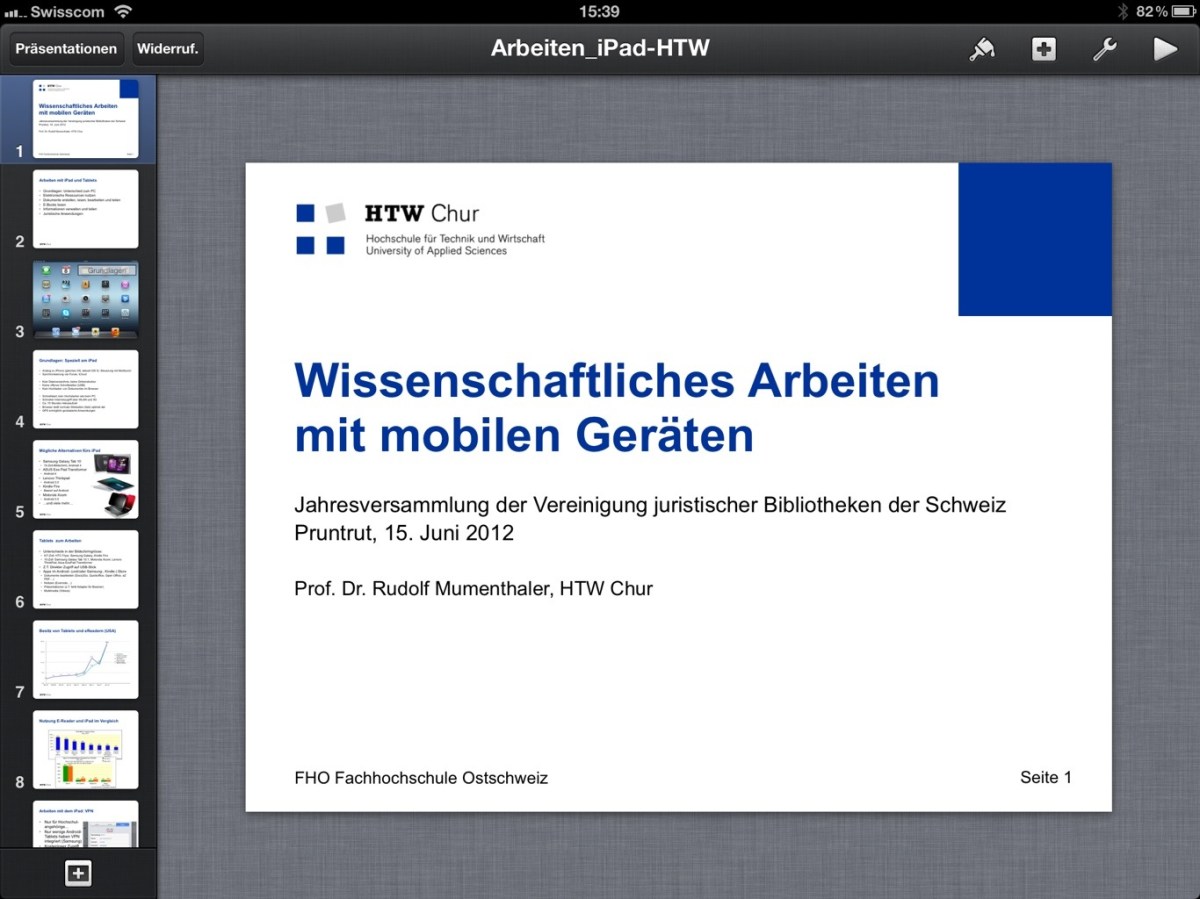
Today I held a presentation about working with mobiles (especially the iPad) in an academic context at the assembly of Swiss Law Libraries in Porrentruy (canton Jura). The slides (in German) are published on SlideShare. I outlined the basic differences between working on a PC/laptop and on a tablet, namely the iPad. There are some apps you need, then it works quite well: especially Dropbox to store and access your documents from anywhere and from any device, and GoodReader to take notes and comments and to highlight in PDF files. If you are a member of a university access to licensed documents (e-books, e-journals) is easy with the integrated VPN connection. iCloud supports the synchronization of text documents (in Pages, but also in Word format), presentations (in Keynote, but also in PowerPoint format) and of spreadsheets from iPad to your PC or Mac. But iCloud is a proprietary service in the Apple ecosystem and not yet perfectly integrated into OS X. In OS Mountain Lion this issue should be solved, see „Documents in the Cloud“ on Apple’s homepage (www.apple.com/chde/osx/). There are also some apps supporting e-learning – like mTouch to work with Moodle, iTunesU for podcasts or Adobe Connect to participate to distant learning and video conferencing.

And I also mentioned tools to get and share information like Flipboard, Zite and Pocket or Mendeley for reference management. As a conclusion I think that tablets support learning and teaching well, but there are always some workarounds needed, for example to exchange documents with other platforms. And typing is faster and more comfortable with a Laptop, if you don’t want to carry a bluetooth keyboard around…

20120628-153954.jpg

Mobile Internet Services and their implication on libraries

Today I had a presentation in Bad Hersfeld, at a library congress (Hessischer Bibliothekstag 2012) about mobiles and their implication on libraries. My presentation in German is published on Slideshare.

At first I lined out some trends that show how important mobile internet usage has become. And the way internet resources are used has changed basically with smartphones and tablets. The browser used to be the main way to get access to online information. Mobile apps and web apps use information on the internet in a direct way.  Mobile users want to get fast access to the information they need. That means for libraries that their websites should be optimized for mobile access. You have to ask, what users are interested in when they are on the way. Of course, they need a mobile version of the OPAC with access to their user account and the possibility to research for information and to order and loan books. Unfortunately services offered by publishers are difficult to be integrated into a mobile library webpage. You hardly find mobile friendly ebook services. Some publishers offer native apps, which have their own interface to search for information (mainly articles). There are also mobile web apps, but libraries can only link to these services from their mobile webpage. I don’t see how these resources could be integrated into a mobile library service at the moment.

I talked also about mobile internet services that have a great impact on user expectations. Libraries can adopt some of these methods, for example location aware services. You can register your library and its locations in Google Places and integrate Google Maps into the mobile website. So it’s possible to find the location of a branch library and get the information how to get there from the place you are at this moment.  Another interesting technology is QR-codes in order to link from a print information to the virtual world.

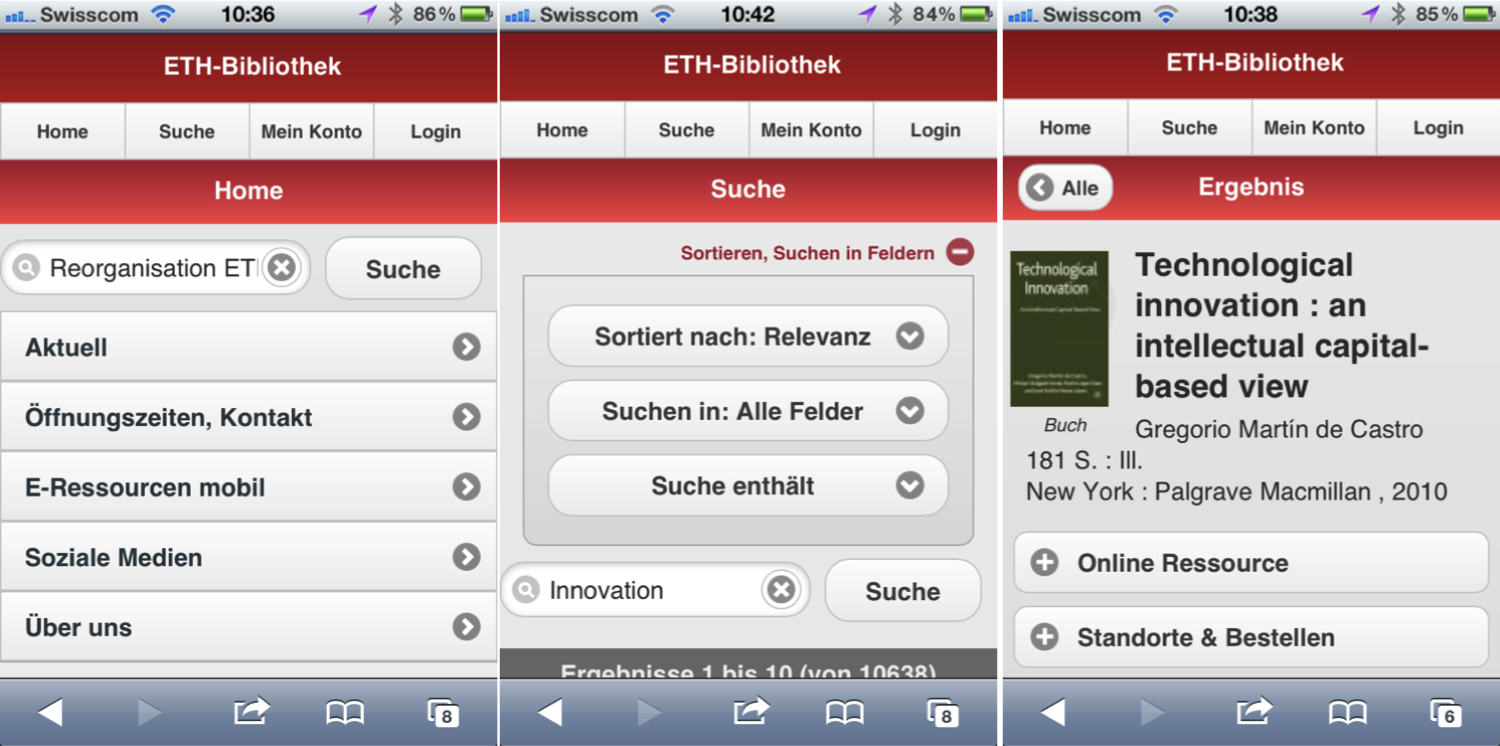
Creating a mobile version of the library’s homepage seems very important to me. If you create one you have to consider some special requirements. Reduce the information as much as possible. Mobile users don’t want to browse and scroll through a lot of background information. They are interested in opening hours, locations and maybe news from the library. At ETH-Bibliothek we added a list with mobile websites of publishers (mobile friendly resources) and mobile versions of its presence on social networks to these basic informations. And like mentioned above, the main function is that of a fully integrated mobile catalogue. See also my blog post in German.

Finally I also mentioned ebooks and how they can be used with mobile devices. In academic libraries where PDF is the format in which ebooks are offered, only tablets and notebooks can be recommended for mobile access. Tablets give also the opportunity to work with these documents (for example with GoodReader on the iPad). But on smartphones and e-reader documents in PDF format are not really user friendly. For these small screens you needed ebooks in EPUB format, but these are hardly available with academic content.